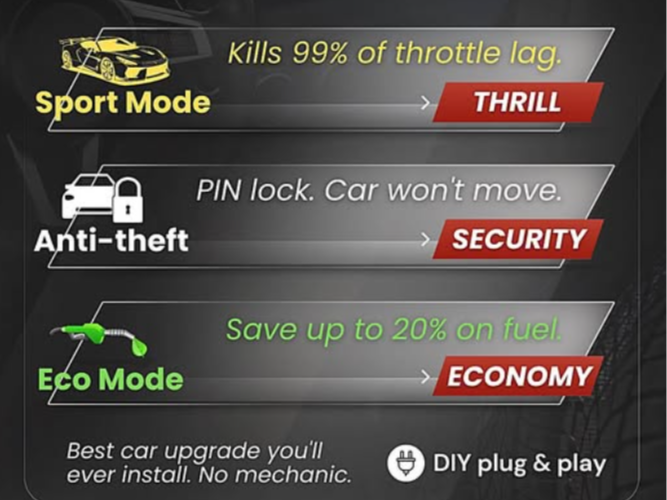
Pedal Commanders Debunked: What $169 Actually Does
Every few weeks one of these ads makes the rounds — bold claims, slick graphics, three “modes,” and a price tag that suggests the device is doing something legitimate. It isn't. Here's what's actually inside the box and why every claim in that ad is either misleading or flat-out false.
What the device actually is
A Pedal Commander, Roar Pedal, Pedal Box, ShiftPower — same product under a hundred brand names — is a passive harness adapter that splices into your accelerator pedal connector. It intercepts the APP (accelerator pedal position) sensor signal between the pedal and the ECM, scales it through a small microcontroller, and passes the modified signal back to the ECM.
That's it. No tuning, no calibration changes, no firmware modification. It's a low-cost adapter that lies to the ECM about how far you're pressing the pedal.
Claim 1: “Kills 99% of throttle lag”
There is no lag to kill. Modern drive-by-wire (ETC) systems respond in single-digit milliseconds — APP signal in, ECM arbitration, throttle blade actuator out. What people perceive as “lag” is the factory pedal map: the APP-to-driver-demand curve is intentionally non-linear for smooth tip-in, fuel economy, and emissions compliance.
A pedal scaler does not change the system response time. It shifts the input curve so that, say, 25% physical pedal travel reports as 50% to the ECM. Your foot moves less to get the same throttle blade angle. The available power, total response time, and maximum throttle opening are identical. You haven't unlocked anything — you've just made the pedal more sensitive at the bottom of its travel.
On torque-based platforms (every GM truck and SUV from the late 2000s forward — Silverado, Sierra, Tahoe, Yukon, Suburban, Escalade), driver demand is filtered through a torque arbitration table anyway. The ECM still owns final authority and will roll back requests for traction control, transmission protection, cat overtemp, and a dozen other limits. A pedal scaler can't override any of that.
Claim 2: “PIN lock. Car won't move.”
This is the most absurd one. A pedal harness adapter is not an anti-theft device. The “lock” mode simply sets the APP scaler to 0%, so the ECM thinks you're not pressing the pedal.
Defeat procedure: pop the kick panel, unplug the adapter, plug the OEM connector back into the pedal assembly. Less than a minute with a flashlight. The vehicle drives normally because the actual immobilizer system — transponder key, BCM, and ECM challenge/response — was never involved.
Real anti-theft on a modern GM vehicle lives in the BCM's VTD/PassLock authentication and the keyed transponder handshake. Not in a pedal harness.
Claim 3: “Save up to 20% on fuel”
Physically impossible from a pedal scaler. Fuel delivery on a modern GM ECM is calculated from:
- MAF-measured airflow (or speed-density via MAP + VE table)
- Commanded AFR (closed-loop feedback from the upstream O2)
- Injector flow rate and commanded pulse width
None of those inputs come from the accelerator pedal. The pedal tells the ECM what torque the driver is requesting. The ECM determines how much airflow will produce that torque and fuels for the measured airflow. Pedal position has no direct relationship to injector pulse width.
“Eco Mode” on these devices works by desensitizing the pedal — you push further for the same response. If you happen to drive with a lighter foot as a result, you'll burn less fuel, exactly the same as if you just drove gentler with no device installed. The hardware itself saves nothing.
What it actually does to your vehicle
Real-world side effects from running a pedal scaler in “Sport” or “Race” mode:
- Tip-in jerkiness. Factory pedal maps are tuned for drivability. Aggressively front-loading the curve makes smooth driving — parking lots, low-speed maneuvers, towing — noticeably worse.
- Transmission behavior changes. On a 6L80E, 6L90, or 8L90, shift scheduling and TCC apply logic look at driver demand torque. Artificially elevated demand causes unwanted downshifts, delayed lockup, and harsher shifts.
- Traction issues. More torque request earlier in the pedal travel = easier to break traction in rain, snow, or with a loaded trailer.
- No fix for the actual problem. If your throttle response genuinely feels lazy, the root cause is in the calibration — driver demand torque table, torque management during shifts, or throttle follower behavior — not in the pedal sensor.
The correct fix
If you want a sharper, more responsive throttle, the right approach is to modify the calibration in the ECM itself:
- Rescale the APP → driver demand torque table
- Adjust torque management during shifts and transient events
- Tune the throttle follower / blade target table where applicable
- Address transmission shift firmness and TCC apply schedules in the same pass
This is done with HP Tuners, EFILive, or equivalent and a J2534-capable interface. The result is permanent, reversible, and tailored to the specific vehicle, modifications, and driving style — without intercepting any sensor signals or adding a failure point in the wiring harness.
The bottom line
A pedal commander is a microcontroller-and-potentiometer harness that shifts your pedal curve. It doesn't reduce lag, it doesn't save fuel, and it doesn't secure your vehicle. At best it's a placebo with a side of worse drivability. At worst it adds an unnecessary connector splice in a safety-critical signal path.
If your throttle response actually bothers you, get the ECM tuned. That's the only fix that does what these devices claim to do — and it does it correctly, at the source.
Want a real throttle fix?
We tune GM ECMs for sharper pedal response, smoother shifts, and torque-management corrections — on every Gen IV and Gen V V8 platform. Mail-order nationwide, includes revisions until it's dialed.
View Tuning Services